
If you work in a company, you’re probably familiar with this: there is a chat system for talking to each other quickly, in writing and on video. Let’s look at Germany: Two thirds of companies there with 20 or more employees now use one. Privately it is even more common: 83 percent of people aged 16 to 74 in Germany use WhatsApp, Signal or something similar. And usually, Germany isn’t the fastest technology adopter.
Today I want to introduce you to Matrix and the apps built on it. To set the scene: Matrix is a small competitor to Teams and Slack, but one built on a different principle.
I have been using Matrix myself for over a year, so I start with the practical side: what the protocol actually is, and how the messenger holds up day to day. Then the money. Matrix costs nothing, so I went looking for who pays for the development. And finally the biggest users, Europe’s public administrations.
For anyone who is not sure what Teams and Slack are actually for in a company, I have added an explainer at the end of this post.
What is Matrix?
Matrix is an open protocol for decentralised communication. Security, in the form of encryption, is central to its design. The protocol is the infrastructure the messenger runs on: the message exchange, the chat rooms, and the technical interfaces. What Matrix does not cover is the interface, the part of the program you actually see and think of as the messenger. There is no Matrix app. The messenger you interact with comes from someone else. You could, for example, use Element.
The Matrix software is open source, so anyone can install it and, depending on the licence, mostly use it for free. We run a Matrix server on our own infrastructure at home. If Matrix is meant to replace Slack in a company, then setting up your own server the way we did makes sense. You can also pay someone to run it for you. That is what gives you full control over user data. Matrix also offers a free account with limited access, which is a good way to try it if you are undecided.
So how does it work?
If you use Matrix, you can pick between several messenger apps. Element is the best known. Some are available on mobile, others as a desktop app, and some run straight in the browser. I use Element as a Windows app, and on my phone I currently run both Element and FluffyChat.
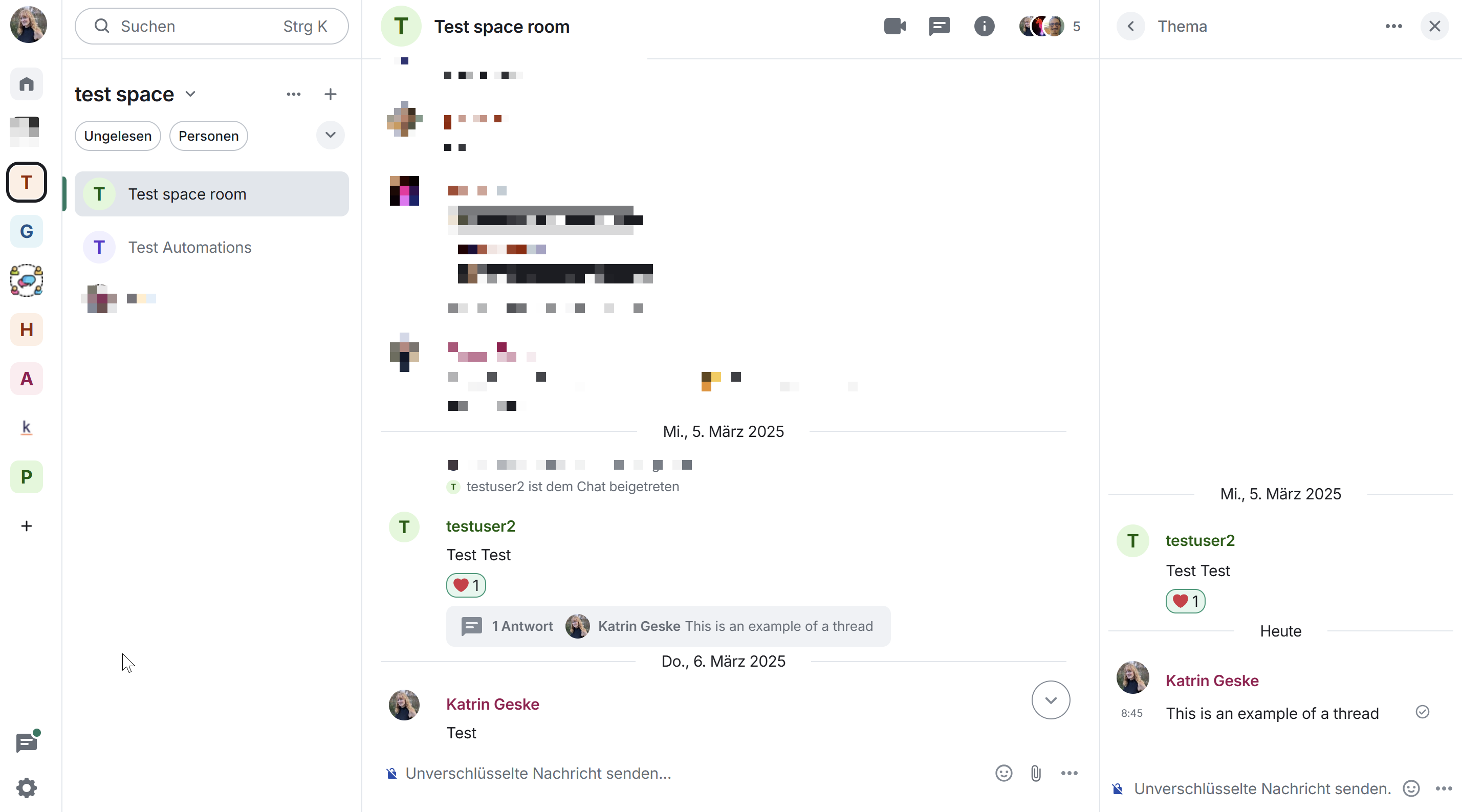
Using it is not always intuitive. When you log in you may have to give the URL of your own server, which is a hurdle for less technical users. Security is central to Matrix too, so signing in on a new device means verifying it from another device or entering a recovery key. If you forget your key, you’ve got a problem, so put it in your password manager straight away.
Once that first hurdle is behind you, it gets easy for anyone who knows Slack, for example: there are rooms and chats, you can talk to people directly or in groups, and video calls are there too.
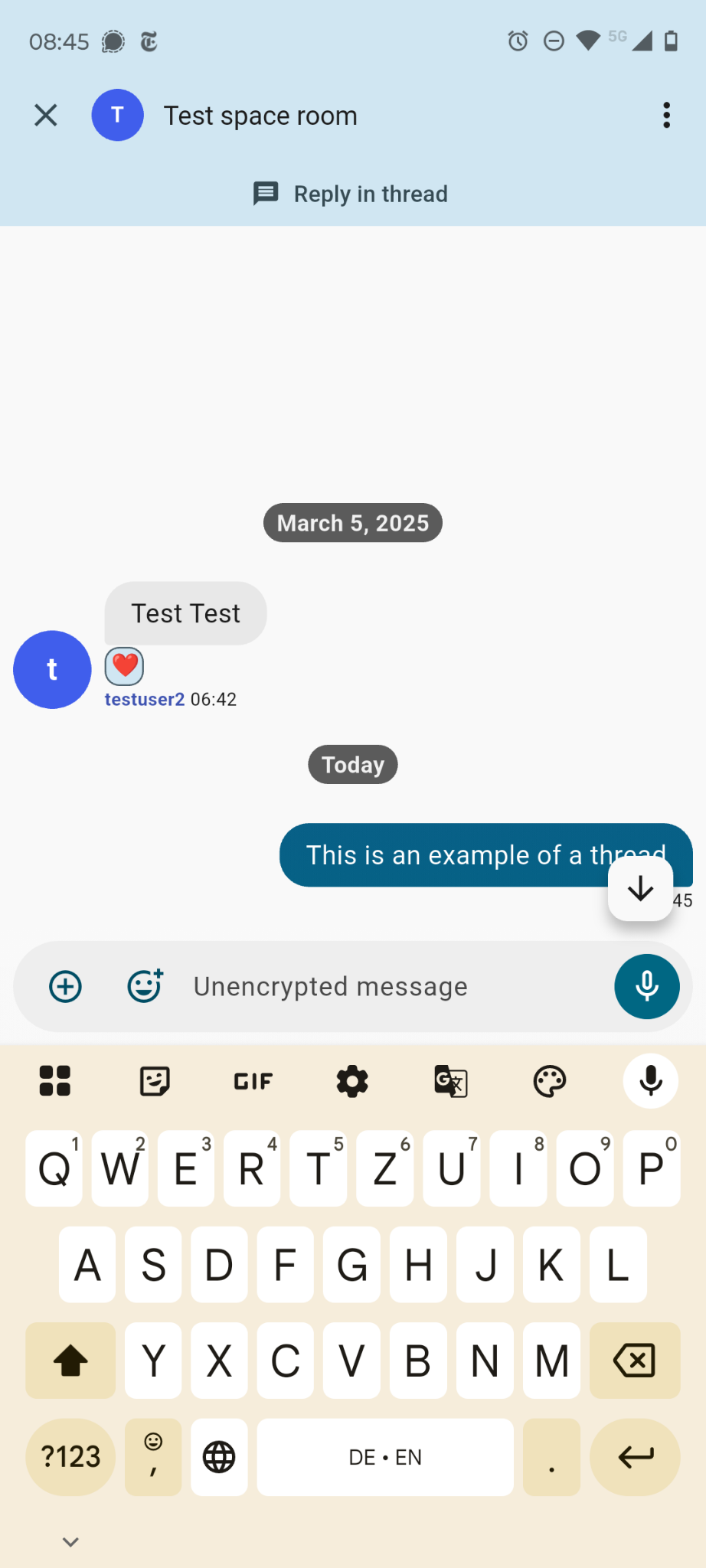
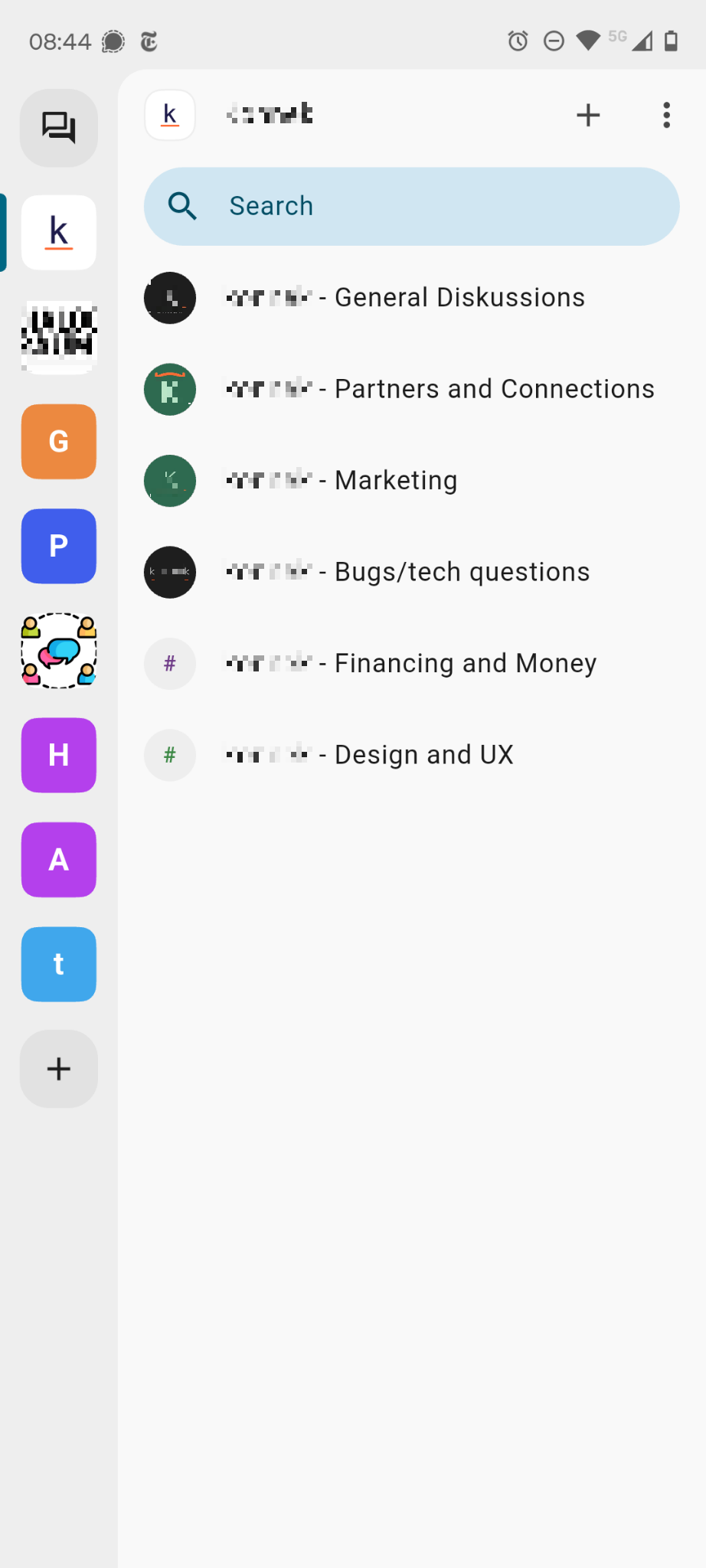
As with other messengers, you see the available rooms on mobile and can chat from there.
The messenger covers what you would expect from a chat tool: public and private rooms, topic-based sections, permissions, video calls, file storage. You can edit messages, and there are threads and replies. The API lets you post messages automatically. I have also built myself a few automations that create new users and add them to groups. That is handy, and not particularly complicated.
Matrix is federated: users on different Matrix instances can meet in shared chats. So if you work on a joint project with several companies, you can invite external Matrix users onto your own server.
But for all those features, Matrix is not Slack or Teams. The market leaders cover project management by now: lists and other collaboration features are built in, there are extensive automations and plenty of feel-good extras. Integrations for Matrix are also not easy to come by. And search is more awkward than on other services, because when the messages are encrypted the server cannot search them. Instead, searches are run in the messenger app, which works better on some devices and apps than on others.
Taken together: anyone moving from Slack to Matrix will probably miss one thing or another, or find it less intuitive to use. In exchange Matrix costs are very low to start with, while Slack and Teams bill per person per month. The data sits on your own infrastructure. And using it means actively supporting a European open source project. Either way, if you do decide to move, good communication and transparency with your team are what carry it.
Which raises an obvious question: if Matrix costs nothing, what do the people live off who maintain the protocol?
Who carries Matrix?
To answer this question, let’s go back to 2014: Matthew Hodgson and Amandine Le Pape began developing Matrix while working at Amdocs. Their vision: an app that brings telephony, video and chat together. The goal was to break up communication silos and make VoIP and instant messaging as ubiquitous and open as email.
Since October 2018 the project has been backed by its own Community Interest Company based in London, a British legal form for non-profit purposes. Its intellectual property is tied down by an asset lock and cannot be sold or handed on. The Foundation sees itself as a neutral steward of the protocol: openness instead of proprietary lock-in, interoperability instead of fragmentation.
That is not the whole story, though. Matrix is tied directly to Element, the company that supplies the chat interface. It was built by the same two founders and carries most of the development: by its own account Element has shouldered over 95 percent of Matrix’s core development. According to the Foundation’s first public annual report, half of its income comes from Automattic’s membership. Revenue has gone up, but the losses are still very high. The Foundation itself writes that it is disproportionately dependent on Element’s contributions, and that this is not sustainable.
Out of those financial difficulties, Element changed the licence of its server implementations in November 2023, Synapse among them, from Apache 2.0 to AGPLv3. That forces certain groups of users either to publish their own code or to buy a commercial licence from Element. Element explained the move by saying it was no longer competitive inside its own ecosystem. It is a clear response to the situation a lot of open source projects are in: the software gets used by plenty of large companies, and those companies contribute little or nothing to keeping it alive.
The big Matrix users are not companies at all, though. They are European public administrations. And almost none of them contribute to the Foundation. Exactly two public bodies are members so far: gematik since June 2023, and the French digital agency DINUM since October 2025. BWI, developing software for the German Bundeswehr (Armed Forces), is buying consulting from Element. But that money goes to the company, not to the Foundation.
The Foundation makes the point itself: open infrastructure should be financed publicly. I find the argument convincing. The list of administrations using Matrix is long. The membership list is not.
Matrix: the messenger for public administration and healthcare?
As the last section revealed, Matrix is especially interesting for public bodies. The reason can be found in the many requirements public software has to meet: data protection has to hold, the source code must be auditable, and communication between agencies should work without both sides having to buy the same product. A federated protocol is built for exactly that.
In France Matrix is most established. The state runs its own Matrix messenger, Tchap, developed by the digital agency DINUM. Since September 2025 public administrations are required to use it.
In Germany the BwMessenger has been in use for the Bundeswehr since late 2020. The BundesMessenger for civilian administration grew out of it in 2023. Using it is not mandatory though, and it is not clear how many active users there really are.
gematik is also developing the TI-Messenger for healthcare. In theory that product sounds really good: providers are meant to communicate securely with other providers and with patients. How far adoption actually gets remains to be seen. But this is the project where the potential of Matrix becomes clearest.
More deployments across Europe:
| Country / institution | What runs there | Status |
|---|---|---|
| Luxembourg | Luxchat4Gov, Matrix-based, data centres in the country | around 25,000 public employees at launch (May 2023) |
| Sweden | Försäkringskassan (Element) and Trafikverket (Rocket.Chat) are connected over Matrix | pilot, expansion planned after the summer of 2026; Matrix is to be recommended as a common standard |
| Austria | University of Innsbruck: Synapse, Element and Jitsi Meet with SSO | 35,000 students and staff, since October 2020 |
| Germany | school messengers ByCS (Bavaria) and Schulchat RLP, plus the Brandenburg police | figures from Element; no user numbers |
And now?
Matrix is an open source communication protocol that is widely used in Europe. In the public sector, at least. Administrations like it, because for them convenience comes second. Full control over the security of the communication channel takes priority. That is why messengers in various countries, institutions and municipalities are built on the Matrix protocol. Most of them then use their own interfaces on top.
And yes, some things get annoying. You do have to keep the recovery key at hand whenever you sign in on a new device, but honestly, that is a small thing. Usability is fine, and I use the well-documented API a lot. I am convinced that, with good training and transparent communication, not just public bodies but larger companies could get on well with Matrix. The switch is often not without friction though, and it takes some sensitivity and solid change management to bring everyone along.
A footnote: what do companies use messengers for anyway?
Common as these systems are, plenty of people have never worked with an internal company chat and might not see the point of one. Hence this footnote, as a short introduction.
Many companies have an internal chat system that every employee has a dedicated user account for. Employees can write to each other directly, the same as on WhatsApp, and there are groups. This is where the applications start to differ though: topic-based groups are central to the internal company systems. Every team has groups where it talks, and then there are projects as well as private and public chats. Therefore, these services carry several different jobs:
- Organising the daily work (operations)
- Coordination on a project
- Talking between teams
- Strategic exchange
- External coordination with partners and customers
These chat systems have largely replaced the phone, because most providers have video conferencing built in.
The well-known providers are quickly listed:
- Microsoft Teams is part of Microsoft 365 and is therefore the easiest choice for most offices. What that advantage is worth is spelled out in a European Commission decision of 12 September 2025. The Commission’s preliminary view: Microsoft has held over 70 to 80 percent of the global market for SaaS productivity applications since at least 2017 (the exact figure is redacted), and tying Teams to those applications abused that dominant position. It never came to a ruling, though. Microsoft offered commitments instead, the Commission made them binding, and that closed a case Slack had started in 2020.
- Slack has belonged to Salesforce since 2021. There is no current user number; the last figure they published themselves was 10 million daily active users in January 2019.
- Mattermost is open source and can be self-hosted, but it is developed by a US company. In Europe CERN and Wikimedia Deutschland use it, among others.
One more thing is worth mentioning: there is no public statistic on which messenger European companies actually use. Eurostat surveys whether companies hold online meetings, not what they hold them with. Bitkom asks about categories, not products. And the German government answers for its own agencies only as classified material.
And you? Does anyone reading this work in an organisation that runs Matrix in production, or tried it and dropped it again? I would especially like to hear how well the apps hold up day to day with less technical colleagues. Get in touch!